Interview and Review by Catie Jarvis
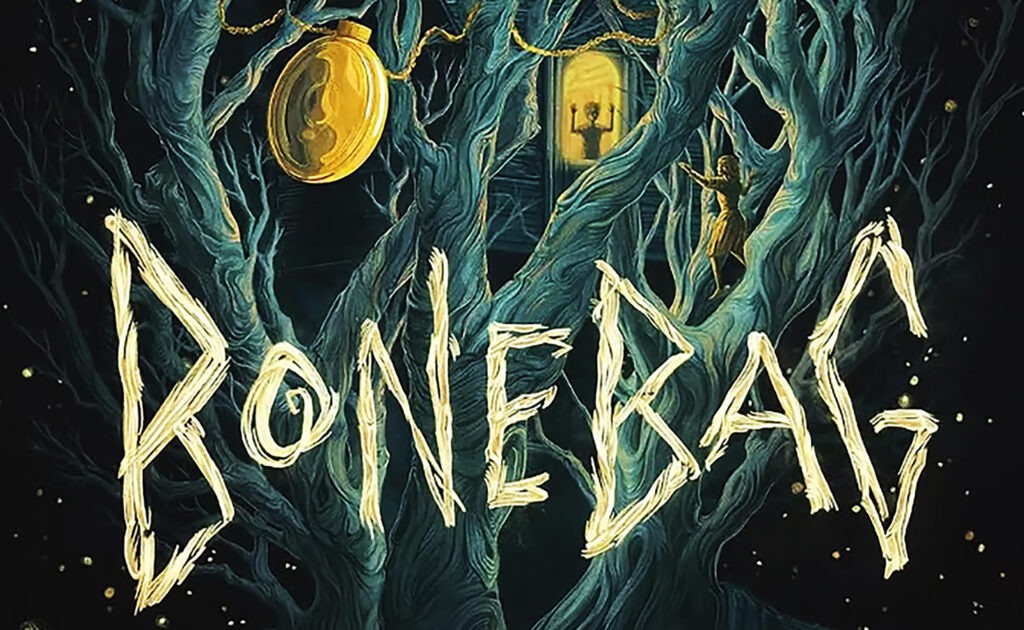
My five-year-old daughter and I spend hours reading together each day. We read in the rocking chair, tent, hammock, on the trampoline. I read to her, she reads to me, we read to ourselves, side-by-side. As a devout writer and reader, nothing could make me happier than this. Nothing except the idea of someday writing a novel alongside my daughter. David Elliot is a dear writing inspiration and mentor of mine and the award-winning author of more than thirty-five books for children and young people. Recently, he wrote the novel, Bonebag, with his son E.M. (Eli) Elliot – and I have been pulled into the dark woods of their collaborative imagination.
Listening, in a Dark Fairy Tale Forest:
It’s rare I find a book written perfectly for youth that I can step right into as an adult. Bonebag is such a book. A children’s horror story, Bonebag feels both classic and entirely new. Like the best fairytales, it stitches childhood and adulthood together by allowing the reader to see the dark adult world through the eyes of the hopeful and innocent.
While Eli is an adult with a child of his own, and David a doting grandfather, their beautifully constructed middle-grade novel has the feel of a story that has been growing within and between the two for a long, long time.
In our email exchanges discussing the book, David told me that he and his wife had read fairy tales to Eli since he was a toddler…

DAVID: “Not the bowdlerized Disney versions, but the hardcore, truth-telling stories of the Brothers Grimm. (A friend once said the difference between these was the difference between Wonder bread and loaves made from whole grain.)
I occasionally still read fairy tales as a good reminder that anything can happen and that there are times when– if we want to live authentic lives – we must enter the dark forest alone.”
In this time of political unrest, where the truths of the world are hard to explain to our children, I feel there’s a deep need for this book, for entering the dark forest alone with an innocent, insightful, empathetic, and courageous narrator guide.
How did the Elliots know what we needed?
They knew, because they listened. In the same way that the brothers, Jacob Grimm and Wilhelm Grimm, must have been listening. In the same way, all great writers are. To their own moment in this human experience. To their hearts.
DAVID: “With Bonebag, we knew our only job was to listen to the story as it struggled to tell itself to us, and then as best we could, honor what we were “hearing” by getting it onto the page. If our young readers see analogs between Bonebag’s fictional world and their own, hooray! If they don’t, hooray! Some will. Some will not. But that doesn’t mean those for whom those analogs didn’t connect are lesser readers or less evolved children, or less anything. It means they simply found something else that spoke to them.
It wasn’t our intention or responsibility to convince our young readers of anything. Kids have enough school marms as it is… It was our responsibility — and we considered it a sacred one — to have faith in them and faith, too, in the transformative, unpredictable power of story.”
I think this is important. Really important. To listen. To have faith in children. And stories.
Faith and Balanced Architecture:
You can tell when a writer has faith in their reader. It bleeds into the narrative, impacts the voice, the authenticity of the characters and of the plot. You can feel it in the construction of the novel.
In Bonebag, the beams and walls are strong, sturdy, trustworthy. The plots are tight, but not so tight that they don’t allow for twists and turns. There is a guiding force in the novel that pushed me through. George Saunders says in fiction we should “Always be escalating” (A Swim in a Pond in the Rain, 153) and I feel that with Bonebag, the Eliotts managed to do that. I hated to put this book down; each chapter builds upon the last, creating a momentum and arc of tension that drives through the novel like a sharp talon. This is admirable and not easy to do. I know because I’ve tried and failed many times in my own novels. Eli assured me that this momentum was intentional, “And very, very challenging.”
Eli shared about the foundations of their process. At the start of the project, they alternated chapters, exchanged edits, and moved forward in small steps.
ELI: “We really treated every chapter like a separate piece.”
In revisions, they took on separate tasks, David smoothed out the geography of The Great City, and Eli modified and enhanced the progression of Bonebag’s ailments.
ELI: “I liked the gross stuff.”
The novel has a high level of craft and intentionality. Carefully woven information and clues, each chapter ending with a point of tension or suspense. But it’s clear to me that this structure supports rather than suffocates the story and characters. A backbone idea that both Eli and David expressed was this emphasis on staying open to the story, rather than forcing it into a shape they predetermined.
DAVID: “I think it was Eudora Welty who said, ‘If you haven’t surprised yourself, you haven’t written.’ I was surprised over and over again how characters and situations that initially seemed incidental took on a life of their own. For example, Toby Lightfingers came into the story only as a convenience, nothing more than a useful vehicle to help create the new world in which Bonebag found himself. Yet almost on his own, he insinuated himself into the narrative and became one of the book’s most affecting characters. It’s a tremendous relief when the writer(s) allow this to happen.”
When asked about the most surprising part of writing this novel with his father, Eli said it was the ending, because the ending allowed him to trust and surprise himself.
ELI: “There were so many surprising things that happened, but for me, it was the ending. My dad and I had a lot of conversations about how this book should end, not just in terms of the plot, but tonally, too. Did we want it to be happy? Sad? Something in-between? It was my job to tackle that final chapter, which was extremely daunting. Bad endings are so disappointing!
I sat for many hours in front of my computer searching for the right way to wrap things up (I think any writer will probably tell you that this is NOT the best way to generate ideas). And after a few days of not much progress, I dreamt it. Not the whole ending, but the last few words. That dream really ended up unlocking that chapter for me, tonally. And thank god, because we were really stuck.”
Novels are a thing of architecture. The spaces left for both the reader and the writer to move through, breathe, and come to their own understandings, are as important as the strength of the beams and walls.
Building Together:
My own father built houses. While I handed shingles up the ladder from time to time and once hit myself in the head with the back of a hammer trying to help hammer in some nails (ouch!), I never got to build a house with my dad. But I would have liked to. I fantasize that if he had lived long enough, I would have sat with him as he drew the plans to my house by hand on his old blueprint paper, pulling dream-rooms from my heart and transforming them into practical geometry, ordering hardy parts that would stand the test of time, and watching ideas rise into concrete being. To construct something with someone we love, someone who has witnessed and impacted our way of being in and understanding the world, is precious. I didn’t get to build a house with my dad, but Eli and David have certainly inspired to me someday build a novel with my daughter (I hope she’ll agree to). Collaboration can lead to a depth of artistry and creation that we may not have been able to reach on our own.
In our email exchanges discussing the book, David told me that he and his wife had read fairy tales to Eli since he was a toddler…
ELI: “My dad and I were deep into our first round of edits when I pitched an idea—one I can’t even remember now—that would have significantly changed the story. My dad listened, paused, then told me that I had “too many ideas”. Ouch.
But I knew what he really meant. I have a sometimes debilitating tendency to overthink, and when you’re facing a blank page (or even a finished draft), overthinking can be fatal to a story, a chapter, even a single sentence. It can lead to endless rewrites or no writing at all.
When my dad said I had too many ideas, what he was really telling me was to move forward. To trust the story we had written (and to trust myself).
That moment stuck with me, but I didn’t fully realize how much it had mattered until I started my first solo novel and found I wasn’t weighed down by “too many ideas.” I was just writing. Not that it was easy. Just easier. Freer. And what greater gift is there than freedom?”
It all weaves together – listening to the world, constructing an intentional architecture with plenty of space for characters to move and live and surprise us. Having faith in the story and the writer and maybe most importantly the reader. Beautiful lessons, and from them, a chilling story. David and E.M. Elliot create uniquely mythical monsters within a world of real monsters and prove to the reader that in life, it is rare and terribly courageous to feel deeply and to put others’ well-being before one’s own. We should all be so lucky as to spend a few hours seeing the world through Bonebag’s eyes.
DAVID: “Once upon a time . . .” We boarded the magic carpet woven by that propulsive phrase, and didn’t get off until it landed at two of the saddest words ever written: The End.”
*Bonebag will be available on May 26, 2026, and is available for pre-order now! Check out David Elliot’s Website to learn more.
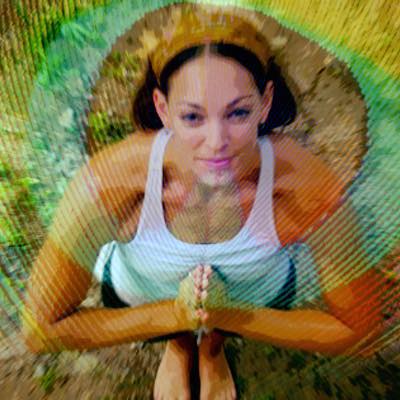 Catie Jarvis is an author, English and Creative Writing Professor, yoga instructor, competitive gymnastics coach, surfer, wife, and mom. She grew up on a lake in northern New Jersey and now lives in Los Angeles. The Peacock Room is her first novel. Stop by catiejarvis.com, Instagram @30inLA